
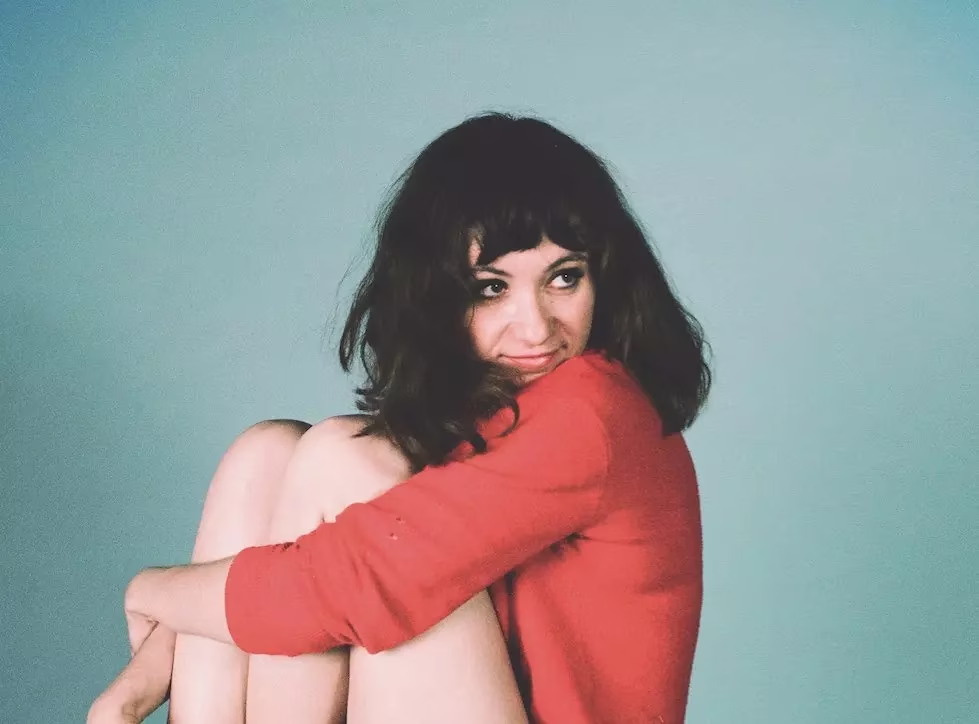
Noël Wells is currently on tour—her first ever as a musician. You might recognize the petite brunette from her 2013 stint on "Saturday Night Live," not to mention a memorable turn opposite Aziz Ansari on season one of "Master Of None" (among other things, like her self-directed 2017 Netflix rom-com Mr. Roosevelt), but it should come as no surprise that the actress and comedian is an equally gifted singer and guitarist.
Though she was in a band in middle school and has always considered herself to be musical, it wasn't until a combination of events, both personal and political, hit in 2016 that she began to actively consider recording an album. The result, the sweetly lo-fi It's So Nice!, dropped in late August. Shifting into music, Wells says, wasn't hard. "I feel like what I'm finding about myself is I'm a song-and-dance man," she says over coffee in Los Angeles, where she's lived now for more than a decade.
<iframe width="620" height="349" src="https://www.youtube.com/embed/YmQc8dndOIg" frameborder="0" allow="accelerometer; autoplay; encrypted-media; gyroscope; picture-in-picture" allowfullscreen></iframe>
On It's So Nice!, Wells effortlessly carves out a place for herself in the music world, writing catchy folk-pop and country-leaning songs that evoke both classic and contemporary figures like Nancy Sinatra and Shania Twain.
Though creating music didn't feel difficult, she says, taking a break from film and television still came with its share of unexpected obstacles. "The problems that women have in the entertainment industry, they're also going to have music," she says. "They're going to have [the same problems] in fashion, they're going to have in schools. I'm a very lucky person [in] that I've seen a lot. I've been at the top of the top and I see what works and what doesn't work and so I'm not afraid of any of it anymore."
Below, Wells opens up further about creating her first-ever album, navigating the business side of the music industry and finding the balance between light and dark on It's So Nice!
I've been following your career through "SNL," through Mr. Roosevelt and through Happy Anniversary. So when I saw that you were releasing an album, I was so excited. And that move didn’t seem surprising.
Yeah. It's funny, I feel like what I'm finding about myself is I'm a song-and-dance man. Do you know what I mean? It's like a full picture. That is kind of where my wheelhouse is and I'm trying to figure out a way to plug in my songs and make use of them, in a way that sustains me and makes me happy.
Your It’s So Nice! album came out about a month ago. How's it felt to release it?
The album, it's been going well. The music industry is a whole other beast.
Yeah, I wanted to ask you about that. As someone who's kind of moved between worlds, what does transitioning to music look like from an industry perspective?
Well, I kind of almost feel like there was a part of me running away from problems I was having. Not problems, but just obstacles I was facing in the entertainment industry and then thinking, "Oh, if I just need music, I won't run into them." Turns out, they're everywhere. You're going to, you have to conquer them one way or the other. So, the problems that women have in the entertainment industry, they're also going to have music. They're going to have in fashion, they're going to have in schools. You know what I mean? So it's like you just can't run away from it anymore. Although, it was good to learn the lesson.
It’s interesting. Now seeing all sides, I feel like I have, I'm a very lucky person that I've seen a lot. I've been at the top of the top and I see what works and what doesn't work and so I'm not afraid of any of it anymore. I think there's a lot of problems. And I can separate myself and my work from the problems.
I think the challenge, too, is learning how to protect your heart.
It's protecting your heart, and the other challenge is I'm trying to align with people that have a similar ethos as me. Which is, I think, a thing that does take time, but that right now it's really getting the right people around me and finding people to collaborate with that make things for the same reasons, or have a similar ambition.
Because it's like, "Look, it's like I'm a nice person but I'm not not ambitious." So I want to be very, very successful, but I also don't want to hurt people on the way up or do bad things.
Yeah, it’s a universally hard thing, I think, as a person with integrity, to watch disingenuous people become really successful.
Yeah. One that I'm just saying very loudly in my head is, "You know what, it's none of my business." Other people, other people's paths or trajectories, how they're doing it. It’s none of my business. Just keep my stuff clean, and just take care of my side of things and be accountable for my work.
It was fascinating to learn how you only began to play guitar a year or so ago. Did you take lessons?
I took lessons. It wasn't very rigorous, but I think that the talent was there... I have a propensity towards music and so I picked it up pretty quickly.
I would like to be a little bit more disciplined so I could learn the instrument a little bit more intimately. But yes, I just recently started playing guitar. Once I started recording, I stopped taking lessons. I tend to learn as I go and as I'm in certain environments, but now that this album's out and doing its thing, I'm like, "Okay, well what do I want to learn next?"
<iframe width="620" height="349" src="https://www.youtube.com/embed/GRCkxEJxE9A" frameborder="0" allow="accelerometer; autoplay; encrypted-media; gyroscope; picture-in-picture" allowfullscreen></iframe>
What was the learning curve like going into the studio? And maybe finding people to work with in the studio?
The learning curve, the creative process of it is very intuitive and it's very similar to anything else that I've done. I've been working in the audio-visual field since I was 18, I went to college for it. I've edited... I've done animation. I kind of worked a little bit with audio. The thing that I had to learn a little bit about is more the business side of it.
What’s been the most challenging aspect of learning the business side of music?
Well, I was hoping people would help me figure things out and then nobody would, and then I would just figure it out and I was like, "Wait, this is what I've done my entire life. Maybe this is actually a skill set that I have."
Well, I really liked the "Played For Keeps" music video. Since it’s so woman-on-the-street, with you running around and rolling around the streets of L.A., did you have to get any sort of permits to film?
Oh, I just had an idea, I was like, "The streets are going to be closed off." I saw an opportunity and I took it, which is the business woman [in me]. Yeah, what I liked about that music video was it was making things the way that I used to make things before life got more complicated.
When I first moved out to L.A., people would just be like, "Hey, do you want to make something?" And people go do it. And then I think with YouTube and people's careers, everything kind of gets complicated and your ambitions and your goals get muddied. And this was like, "Hey, I don't exactly know what we're going to do, but I got this camera, I have a few ideas and here's what we're going to do with the song." And I asked my friend Tim Nikashi, who I've known since I've moved here, and he directed it. And it was great.
My whole thing is I just want everything to be we're all kind of in this together and well they're my projects and I have to hold the reigns on it. It's like we shouldn't be exploiting each other. We should be growing and learning and this should be for everybody. And learning how to navigate that with music was just different because there's just the different ethos.
Were you a big music fan growing up? Did any of your favorite artists inform your sound?
Yeah, it's funny. What I listened to as a kid was just whatever's on the radio and albums that my mom was really into. So it was Jewel or Prince and Shania Twain. I listened to a lot of Shania Twain. And I remember when I got Napster I downloaded a lot of Nancy Sinatra and Doris Day. But I wasn't really super critically listening to music ultil my mid-20s, and even then even when I was, I started listening to the Beatles.
I think the Beatles, the Pixies, Weezer were sort of my I-love-music phase. And I think that those sounds all sort of seep into country music, you know what I mean? I'm from Texas, that's in me. Top 40 music that's just in the ethos. And then I think that those bands sort of made an imprint, and then when I was making the album, I was listening to a lot of music, and none of that directly influenced it sound-wise. But I think [I was most influenced by] the heartbreak people were singing about. It was kind of where I was at. I was like, "Oh man, I just really like... Oh, I get George Harrison's solo work." Or, "I love Van Morrison." Or, this woman Sybil Baier. I love this sad music she does a lot of. I'm connecting with the sadness more than the production or the sounds of it.
I think that that is probably why music was so exciting to follow and be like, "Oh, I can tap in to this thing that speaks bigger than even just my own experience." The way the music was finding me at that time was pretty magical. And I was like, "Somebody recorded a song seven years ago and I'm finding it and it's saying exactly what I'm thinking. How cool is that that you can create something that then can be transmitted through space and time and reach a person?"
<iframe width="620" height="349" src="https://www.youtube.com/embed/2HKxhSy1gT8" frameborder="0" allow="accelerometer; autoplay; encrypted-media; gyroscope; picture-in-picture" allowfullscreen></iframe>
Can you describe your thought behind the album’s name? I sense a duality in putting an exclamation point at the end of It’s So Nice!, and yet your singing has a bittersweet quality.
I'm not going to lie, I was, I felt really confident with the exclamation point and then I got very shy about it, but it is the duality of it. The song, "It's So Nice!" the way that I originally wrote it was a very sad two-chord folk song. It's sort of a soulful, plaintive, song.
The idea is it is the duality, which is that even in our darkest moments that's where you can see the most meaning. That's essentially the whole point. And it's definitely my point of view. I feel like I see everything. I see both the light and the dark, and it kind of goes hand in hand. I personally want to go more towards the light, but I feel for the dark.
I want the dark to come with us. It's like I want to help the dark. I think people think of me as a very cute, nice person, which I'm sure I [am], but I have a very dark sense of humor and a lot of times people don't know how to handle it or they don't. I'll tell jokes and people don't understand what I'm saying. Unless you're one of my friends, it's like, "Oh, she's just saying a joke that if a guy said everybody would be like, ‘He's so funny.’"
Right, I think that a lot of people in this country don't expect dark humor to come out of women because we're, well, we're socialized to be nice here.
I think that America is a very busted place that has a lot of beauty in it. And I think that people are trained to exploit people and there are people that are allowed to exploit people in our culture and there are people that get exploited. And that is everywhere.
The cool thing about art is, art transcends those dynamics. But when there are certain types of gatekeepers who are doing those sort of exchanges of exploitation, it's hard to get your work done. That's it. It's just, my goal is; I just really want to make really good, beautiful stuff and I want to be able to take care of myself and I want to help people that are also talented, find their voices in their ways in a way that I wish somebody would've helped me.
Jenny Lewis On Loving L.A., Texting With Beck & Why 'On The Line' Is Just "One Piece Of The Puzzle"
