
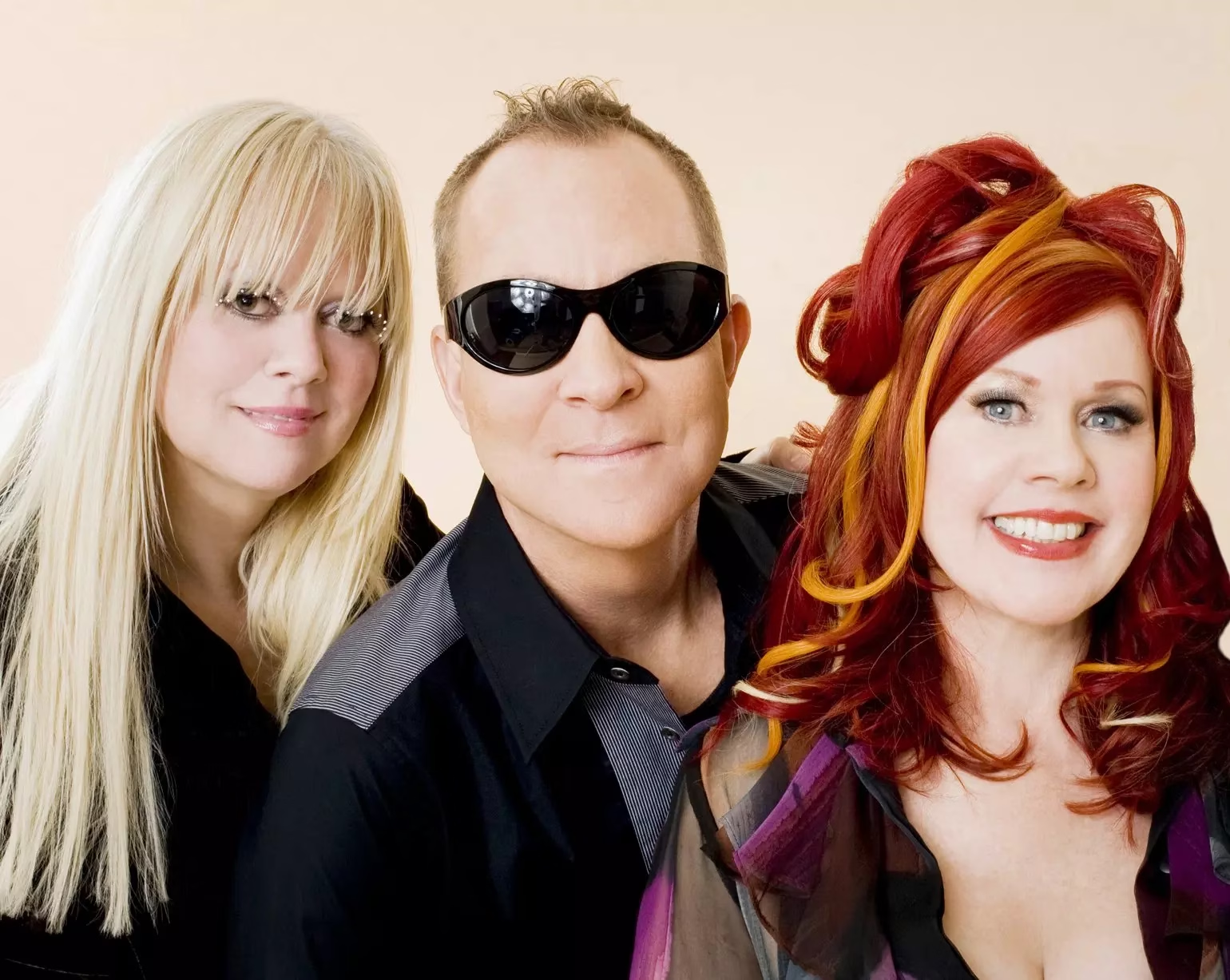
Few bands are both frequently written off as kitsch and lauded as queer-punk heroes—but that’s the very important role that the B-52s play in the history of American rock music. That strange fusion propelled them quickly from house parties in Athens, Georgia to iconic clubs in New York, playing with Talking Heads and Blondie. They made their way around the world, bringing joyful pop hooks to the punks and shimmering eccentricity to the masses. The quintet of Fred Schneider, Kate Pierson, Keith Strickland, Cindy Wilson and her brother Ricky injected oddball party-punk jams like "Rock Lobster" and "Private Idaho" directly into the pop culture mainstream. But after nearly a decade of success, the band were shocked by the tragic AIDS-related passing of Ricky Wilson in 1985 at age 32, leading to a long hiatus.
In hindsight, it’s superbly fitting that the group’s return, 1989’s Cosmic Thing, was released in June. Yes, it’s the record that features “Loveshack”, but even that undeniable party anthem is a rebellion in the midst of a record full of it. While their ability to insert a surreal sense of humor, double entendre lyrics, and drag-adjacent outfits and beehive hairdos directly into the mainstream was always an act of sublime subversion, the fact that four of the band’s members have expressed their openly queer identities makes every song its own protest. And the stakes couldn’t have been higher than on Cosmic Thing, mourning the death of a friend, a comrade, a brother, from a disease that the mainstream would often avoid at all costs—in fact, a mainstream that would often avoid queer lives entirely.
Twenty years after the album’s release, The Recording Academy poke with Kate Pierson and Keith Strickland to discuss the impact and lasting legacy of Cosmic Thing—both as a sublime musical statement and an important moment in queer music history from an essential American rock act.
“IT WAS UP, UP, UP, THEN DOWN, DOWN, THEN MIDDLE OUT”
The B-52’s came together in the mid-’70s over exotic drinks at a Chinese restaurant, and their first concert was at a Valentine’s Day house party. Bringing punk, new wave, surf, dance, and more together, the Athens, Georgia band quickly became a national name on the back of the iconic “Rock Lobster”—and never looked back.
Kate Pierson: Somehow coming out of Athens, Georgia, seemed like we were from a lunar colony to some people. Where the heck is Athens Georgia? Aren’t they from England? Aren’t Kate and Cindy drag queens?
With our group of friends, nobody differentiated by gender or gender orientation. It was always, “We’re queer, we’re here, we’re weird, we’re having fun making music together.” Crashing parties, wearing crazy outfits, wearing wigs—yes, some people threw some bottles and bricks at us at a frat bar, but later that year, “Planet Claire” was blasting out of the fraternity house. Our first record took off like a rocket. We received a lot of critical acclaim for the first two albums, the touring was strong, and we were growing a fan base, having fun and dancing. Our very first tour was in support of Talking Heads, and we went to Europe, South America, Japan, Australia, and New Zealand.
Keith Strickland: I think we've been surprised each time we've entered onto a new stage of acceptance. The B-52s were born out of a rather unique and accepting community. We've always been our queer selves. Our only agenda has been to make good music; the rest is simply an expression of who we are as individuals. Maybe, just by being ourselves, we've inspired others to feel good about being themselves, too.
KP: After a couple of years of intense touring, we were pressed to do our third record, Mesopotamia. It seemed like a natural choice to work with David Byrne as producer, and the results were great except that we were rushed by our manager and really couldn’t finish and make a full record. But “Mesopotamia” as a song actually became very popular and was a crossover hit with so-called “urban radio.” Even today I don’t know what all the rush was for, except to perhaps keep the momentum going. In Whammy, we changed our sound even more to electro dance, with drum machines and synths. Overall, it was up, up, up, then down, down, then middle out.
The B-52s in 1980. Photo credit: Richard McCaffrey/Michael Ochs Archive/Getty Images
"WE COULDN’T IMAGINE CONTINUING WITHOUT HIM"
After a rapidly asserting their unique personality, the band reached a further experimental high on Bouncing Off the Satellites. The album was recorded in 1985, just prior to the death of Ricky Wilson. Strickland was the only one who knew the extent of Ricky’s illness, but his passing prior to the record’s release threw the band into a depression.
KP: Our “agenda“ wasn’t at first necessarily related to “queerness,” but more universal—putting lyrics in that referenced political ideas. But later, after Ricky’s death, we became much more activist, becoming involved with PETA, environmental causes, LGBTQA rights, and especially AIDS activism. During this time, many other friends were dying of AIDS; it was terrifying and sad, and we joined in to do what we could and speak out.
KS: After Ricky Wilson died, we felt that the band was finished. We couldn't imagine continuing without him. So, we each went our separate ways. I moved from Manhattan to Woodstock, New York, and rented a little cabin in the mountains. Eventually, I began writing music again, just for myself. I really didn’t know what else to do.
KP: Warner Bros. figured since we weren’t touring after Ricky died that they would just not promote the record. We all went through so many changes—especially without touring, and the record just dropped like a stone—and we all dealt with our grief. Keith Strickland moved to Woodstock, and I got a part-time house there across the pond from him. I would go in my canoe over to his house all the time. He started writing music again, and that got the spark going—just trying to get together again, partly as a healing process and partly because the planets aligned.
We realized what a precious thing we had to be able to create music together.
"Maybe, just by being ourselves, we've inspired others to feel good about being themselves, too."
KS: I visited Kate and Cindy in New York and played a cassette for them of some music that I was working on. Soon after that, we all discussed and agreed to try writing together again. We took a year to write Cosmic Thing. We spent a lot of days just talking, which was an essential part of the creative process for us. It was healing. We became our own support group. I wasn't sure if we could do it without Ricky. We knew it was going to be a different band without him, and we had to find out what that was.
KP: This time Keith was writing all the instrumentation. He brought tracks into a studio where we started working in lower Manhattan, commuting four days a week from Woodstock. We went back to our usual jamming process, only this time layered over his tracks. Cindy, Fred, and I would collage the pieces together to form the songs. Sometimes what Keith thought would be the chorus turned out to be the verse, and things had to be rearranged.
"WE PROVED TO OURSELVES THAT WE COULD DO IT"
Though “Love Shack” quickly became the band's best-selling single (eventually going double platinum), Cosmic Thing brims with karaoke hooks and dance-along grooves. And in fact, each one can be considered a rebellion against the oppressive reality of the toll that the AIDS epidemic was taking on the band and the queer community at large. Though "Love Shack" may be a pop radio mainstay and the song the band is most known for, its refusal to find anything but joy in togetherness is a far deeper statement than it might seem at first glance. And those same themes power most of the record's immersive and bubbling 47 minutes.
KS: "June Bug" was the first song we completed. That was significant. We proved to ourselves that we could do it.
When we played our demos for Don Was, “Love Shack” was still unfinished. We couldn't agree on a chorus. Don and Kate both suggested repeating a section which had only occurred once on our demo. We tried it, and suddenly the song had a chorus and fell into place. When we recorded it in the studio, it really felt good. It definitely had a vibe. Radio stations wouldn't play “Love Shack in the beginning. It wasn't until the video started getting airplay that it got picked up by radio, that's when I thought that we might have a hit. The song always brings back good memories for me now.
<iframe width="620" height="349" src="https://www.youtube.com/embed/9SOryJvTAGs" frameborder="0" allow="accelerometer; autoplay; encrypted-media; gyroscope; picture-in-picture" allowfullscreen></iframe>
KP: "Love Shack" went through several versions, but when we finally rehearsed it at Dreamland Studios with Don Was, it all came together. It definitely stood out as a hit, especially when we played it for REM. They were wowed by it. It still is one of my favorite songs. "Roam" became a big hit, as well, and the lyrics were written by our friend Robert Waldrop. Like "Love Shack," those lyrics and harmonies beam out a spirit of freedom and universal love.
KS: "Roam" and "Love Shack" both felt really strong to me. I was hoping they would be a success, but I didn't expect it.
KP: Really the success of Cosmic Thing was totally unexpected. We wrote it as a healing process, just for ourselves, without any expectations at all. It really came from our hearts.
KS: When I was writing the music that became "Deadbeat Club," I remember being in a kind of reflective and nostalgic state of mind—playing the guitar while imagining Ricky playing along. Ricky and I had been playing music together since we were teenagers. I've always felt that Kate, Cindy and Fred intuitively picked up on those feelings when they started singing about those early years in Athens before the band began. The lyrics just happened spontaneously during the jam session.
KP: "Deadbeat Club" is so bittersweet. The melody and lyrics mostly came out of our first jam, which is pretty unusual. It just poured straight out from our collective unconscious. Keith's beautiful instrumentation triggered something that I think really recalled our times when we started with Ricky. The video by Jeff Preiss that followed really captured the spirit of Athens in that time.
The B-52s in 1989. Photo credit: Fryderyk Gabowicz/picture alliance via Getty Images
"IT WAS TRULY A WHIRLWIND"
While Cosmic Thing put B-52s back in the forefront of the public consciousness, actually getting out in front of people and bringing those raw emotions to crowds (and without Ricky's guitar work) was a completely different challenge. But the crowds were there for the insistent fun, and the experience put the band’s hometown of Athens more solidly on the map.
KP: It was truly a whirlwind. We started out in smaller venues, before “Love Shack” gathered steam and we started playing larger theaters. Then “Roam” kicked in and we began playing much larger venues. We toured the world with an amazing reception. We toured for at least a year and a half and we were pretty tired after that, but it was exhilarating to have that success and to see how much fun and joy the fans were having.
<iframe width="620" height="349" src="https://www.youtube.com/embed/iNwC0sp-uA4" frameborder="0" allow="accelerometer; autoplay; encrypted-media; gyroscope; picture-in-picture" allowfullscreen></iframe>
KS: How to do it without Ricky was, of course, was our first concern. Ricky always played guitar in open tunings, and my concern was finding someone who could do that and would get Ricky's harmonic sensibility. He and I would often play different instruments when we wrote together, so I was already familiar with open tunings, and since I had written all the guitar parts for the new album using open tunings, I volunteered to switch to guitar. Then we auditioned drummers and bass players and assembled a new band. It was a new model. It was like we were starting over.
KP: Athens will always be my home away from home. Amazing things are always happening there, and although it has changed a lot, it’s actually getting better. It’s a tolerant, happening hotbed of creativity now. But it’s the little farming town I moved into in 1973 to do my “back to the land” thing and raise goats in my little love shack 5 miles out of town. It still has that rural feel, mixed with music and Magnolia blossoms.
KS: It was inspiring to watch the music scene in Athens grow. I think it was inevitable that it was going to happen. In the early ‘80s, the indie music scene was sprouting up all around the country. It was amazing being a part of that kind of creative movement. We started the band to entertain ourselves, and I think that has continued to be our central motivation throughout our career. I've tried not to pay too much attention to how we're perceived. I've never felt any duality in being queer, out, and producing fun music. It's all one seamless activity to me.
The B-52's Announce 40th Anniversary World Tour With Berlin & OMD
